
Next Word Prediction — LSTM Language Model
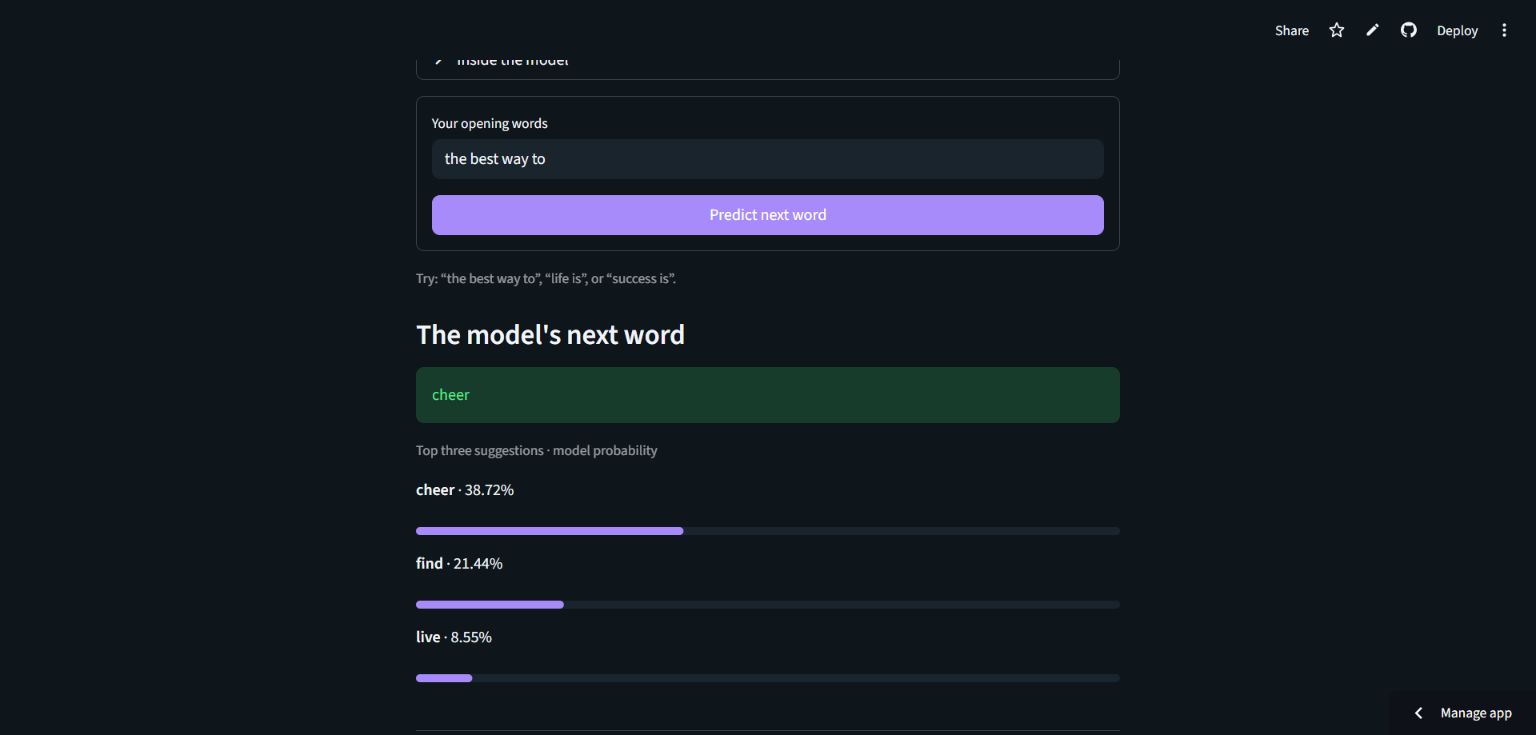
A next-word prediction application powered by a trained TensorFlow/Keras LSTM. The Streamlit interface tokenizes partial sentences, prepares the saved model's input sequence, and displays three ranked next-word suggestions with their model probabilities.
The problem
A next-word prediction application powered by a trained TensorFlow/Keras LSTM. The Streamlit interface tokenizes partial sentences, prepares the saved model's input sequence, and displays three ranked next-word suggestions with their model probabilities.
My contribution
Connected the trained LSTM, tokenizer, and sequence metadata to a Streamlit application; implemented input validation, CPU inference, cached resource loading, ranked vocabulary decoding, and cloud deployment.
Product features
- Partial-sentence input with three ranked next-word suggestions
- CPU inference using the original trained Keras H5 model
- Saved tokenizer with padding and truncation aligned to the model input shape
- Ranked vocabulary predictions with a visible probability distribution
- Cached model resources across Streamlit interface reruns
- Input validation for empty, oversized, and unknown phrases
Engineering work
- End-to-end model inference: Tokenize a partial sentence, pad or truncate to the saved model's input shape, execute the LSTM on CPU, and decode three ranked predictions back to vocabulary words.
- Reusable model resources: Cache the original model and tokenizer across Streamlit reruns, load weights without training state, and bound CPU thread counts.
- Validated inference: Reject empty, oversized, or unknown phrases and present three ranked words with their probability distribution.
Outcome
Delivers the trained sequence model through a browser interface, with three ranked word suggestions and cached CPU inference that reuses model resources across requests.